The Truth About AI and Job Loss: What You Really Need to Know
AI is transforming the job market, raising concerns about widespread job loss. This article explores which jobs are at risk, which are safe, and how workers can adapt to thrive in an AI-powered future.
7/21/20253 min read

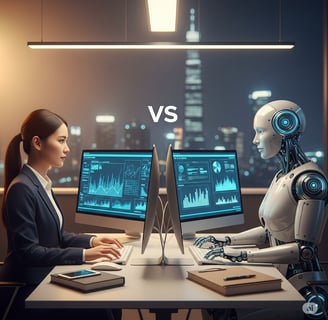
Artificial Intelligence (AI) is rapidly transforming the way we live and work. From automating repetitive tasks to enhancing data analysis, AI is being integrated into industries at a pace not seen since the industrial revolution. But as AI continues to evolve, a critical question arises: Will AI kill more jobs than it creates?
This is a pressing concern for workers, employers, and policymakers alike. The answer, as it turns out, is more nuanced than a simple yes or no.
The History of Technological Disruption
To understand what AI might do to the job market, it's useful to look at history. Technological advancements—from the printing press to the internet—have always disrupted existing jobs. The industrial revolution, for example, displaced many manual laborers, but it also gave rise to factory jobs, engineering roles, and entirely new sectors.
The key takeaway? Technology eliminates some jobs but often creates others.
What Makes AI Different?
AI differs from past technologies in a few important ways:
It’s cognitive, not just mechanical. AI can analyze data, generate content, and make decisions—tasks previously thought to be uniquely human.
It’s scalable. A single AI system can perform the work of many people, potentially replacing large teams.
It evolves rapidly. With machine learning, AI systems can improve over time, reducing the need for human oversight.
These capabilities make AI especially potent in automating not just physical labor, but also tasks in finance, customer service, education, and even healthcare.
Jobs at Risk
Some roles are more vulnerable to automation than others. These include:
Repetitive administrative tasks: data entry, scheduling, and form processing.
Manufacturing and logistics: assembly line work, inventory tracking, and delivery.
Customer service: chatbots and virtual assistants are increasingly handling routine inquiries.
A 2023 report by Goldman Sachs estimated that up to 300 million full-time jobs globally could be affected by AI automation. That doesn't mean all those jobs will disappear, but many will be significantly changed or relocated.
Jobs That AI Is Unlikely to Replace
There are also many jobs where humans still have the edge:
Creative fields: while AI can generate text or images, human creativity, originality, and emotional depth are hard to replicate.
Skilled trades: plumbing, electrical work, and construction involve unpredictable environments and require manual dexterity.
Healthcare professionals: empathy, trust, and nuanced clinical judgment remain essential in medicine.
AI and tech jobs: ironically, AI is creating demand for roles like data scientists, machine learning engineers, and AI ethicists.
In fact, many new jobs are being created by AI itself—jobs that didn’t exist a decade ago.
The Human-AI Partnership
Rather than replacing humans entirely, AI often works alongside people. For example:
Doctors use AI to help diagnose diseases faster and more accurately.
Marketers use AI to analyze consumer data and improve campaigns.
Writers and designers use AI tools to brainstorm and speed up content creation.
In these cases, AI augments human capabilities, making people more productive rather than obsolete.
The Skills Gap
One of the biggest challenges isn’t just job loss—it’s job mismatch.
Many people may find their current roles evolving or disappearing, while new roles require entirely different skills. Upskilling and reskilling become crucial. Key skills for the future include:
Digital literacy
Data analysis
Critical thinking
Adaptability
Communication
Governments, schools, and companies all have a role to play in preparing the workforce for these changes.
So, Will AI Kill More Jobs Than It Creates?
The short answer: It depends.
In the short term, AI is likely to displace certain jobs, especially repetitive and rule-based roles.
In the long term, it may create more opportunities, especially if businesses and governments invest in education and workforce development.
History shows that societies can adapt to technological shifts—but the transition can be painful without proper planning.
Final Thoughts
AI will change the nature of work—but whether it kills more jobs than it creates is not predetermined. The outcome depends on how we respond.
Will we invest in training? Will we create safety nets for those displaced? Will we shape AI policy to prioritize human well-being?
The future of work is still being written—and we all have a part in shaping it.