The Future Landscape: Predictions for Human-AI Collaboration and Competition
Will AI be our greatest partner—or fiercest competitor? Explore future predictions for human-AI collaboration through 2025, 2030, and 2040, and learn what it will take to thrive alongside intelligent systems.
7/7/20243 min read
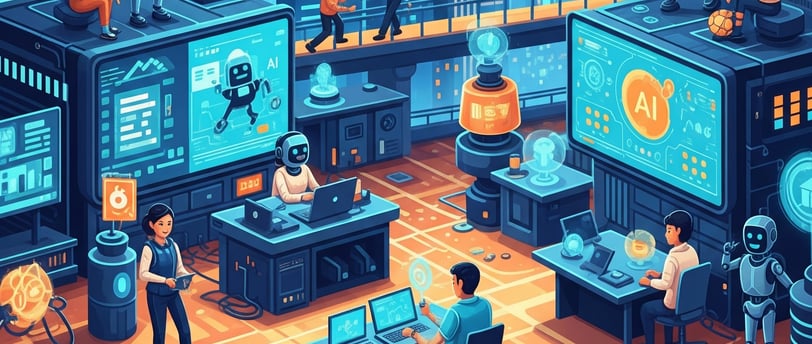
Exploring AI future predictions for 2025, 2030, and 2040—and the path to coexistence with intelligent systems
Introduction: Will We Work With AI—or Compete Against It?
The rise of artificial intelligence is no longer theoretical—it's accelerating at an unprecedented pace. From coding assistants and robotic surgeons to AI-powered CEOs, we’re already witnessing glimpses of a future shaped by increasingly intelligent machines. The question now is not if AI will transform our lives, but how it will reshape the relationship between humans and machines over the next two decades.
Will we forge a partnership that enhances our capabilities—or enter a high-stakes competition for relevance, control, and survival? In this article, we explore AI future predictions for 2025, 2030, and 2040, focusing on the evolving collaboration between humans and machines, and the conditions necessary for sustainable coexistence with intelligent systems.
1. 2025: The Age of Augmented Intelligence Begins
By 2025, AI will not replace most humans—but it will significantly augment human performance in a wide range of industries:
Healthcare: AI-assisted diagnostics will become routine, enhancing doctor accuracy and improving early detection rates.
Education: Personalized AI tutors will adapt learning content in real-time, boosting student outcomes.
Workforce Tools: AI will be deeply embedded in productivity platforms, automating research, writing, and data analysis.
Human-AI collaboration will become the norm in white-collar professions. Knowledge workers who learn to work with AI—rather than compete against it—will thrive.
🔍 Key Insight: The shift from artificial to augmented intelligence will define the workplace of 2025.
2. 2030: Competition Heats Up in High-Skill Domains
As AI systems become more autonomous and creative, the line between human and machine expertise will blur:
Creative Industries: AI-generated art, literature, and music will rival human creations—not just technically, but emotionally.
Finance & Law: AI will analyze complex legal documents and financial models faster and more accurately than professionals.
Engineering & Research: Machines will design new materials, run simulations, and even generate scientific hypotheses.
While collaboration will continue, competition will intensify. Humans will need to develop “meta-skills” like critical thinking, emotional intelligence, and ethical reasoning—areas where machines still struggle.
⚠️ Ethical Challenge: Will AI outperform humans in professions that once seemed uniquely human?
3. 2040: Toward Coexistence with Intelligent Systems
By 2040, AI systems may reach (or approach) general intelligence, capable of abstract thought, long-term planning, and autonomous decision-making across domains. This future demands a new social contract:
Governance Models: We’ll need robust policies to regulate AI behavior and ensure alignment with human values.
Redefining Labor: As machines perform more cognitive tasks, the nature—and necessity—of human work may change.
Coexistence Frameworks: AI won’t just be tools; they’ll be actors in our economic, political, and social systems.
This era could unlock unprecedented prosperity—or profound instability—depending on how wisely we navigate the transition.
🌐 Vision for 2040: True coexistence with intelligent systems will depend on trust, transparency, and shared purpose.
4. The Human Edge: What Can We Do That AI Can’t?
To maintain relevance and influence in an AI-dominated future, humans must lean into distinctly human qualities:
Empathy & Ethics: Machines may mimic behavior, but only humans can navigate complex moral landscapes.
Purpose & Meaning: AI can analyze data, but it cannot understand what it means to matter.
Cultural Intelligence: The nuances of context, identity, and lived experience are still beyond machine comprehension.
✅ Collaboration between humans and machines must center on complementary strengths—not mimicry.
Conclusion: Shaping the Future Before It Shapes Us
The future isn’t set in stone. Whether we end up competing with or coexisting alongside intelligent machines depends on the choices we make today. Proactive regulation, ethical design, lifelong learning, and inclusive dialogue will be essential as we move from 2025 through 2040 and beyond.
We have an opportunity—and a responsibility—to build a future where humans and AI collaborate to create something greater than either could alone.