The Dark Side of AI: How Deepfakes, Data Breaches & Smart Malware Are Redefining Cybercrime
In this blog, we explore how AI-powered threats are escalating the cybersecurity landscape: how deepfakes deceive, smart malware disrupts, and automated breaches devastate. We’ll unravel the technology fueling these attacks, highlight real-world cases, and share expert strategies to protect yourself.
7/16/20253 min read

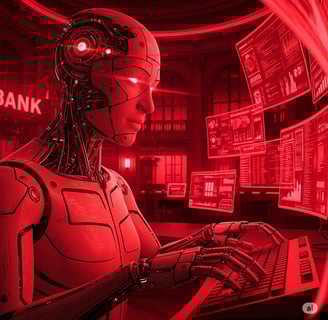
Artificial intelligence has revolutionized our world—transforming industries, boosting efficiency, and enabling breakthroughs once thought impossible. But as AI’s capabilities expand, so does its potential for misuse. Today, AI isn't just a tool for good; it's also empowering a new breed of cybercriminals. From sophisticated deepfake scams to AI-driven ransomware, the dark side of AI in cybercrime is real—and growing.
Why AI Is a Game-Changer for Cybercriminals
A. Automation at Scale
AI scripts can automate large-scale reconnaissance and phishing campaigns, reaching millions while tailoring messages with startling precision. Compared to manual efforts, AI-driven automation is faster, more scalable, and harder to combat.
B. Smarter, More Adaptive Malware
Traditional malware is often detectable by signature-based security tools. But AI-powered malware learns and adapts in real time—mutating its behavior to evade detection and persisting in victim systems far longer.
C. Deepfake Deception—Beyond What Meets the Eye
Deepfakes use generative AI to create eerily realistic fake audio, video, and images. These manipulations deceive victims and bypass traditional security checks, enabling everything from executive impersonation to fraudulent schemes.
From Deepfakes to Data Breaches: Key Threats
🔐 1 Deepfake Scams & Voice Cloning
What’s happening? Criminals use deep learning to mimic voices and faces. A recent case involved a CEO being duped into transferring €220,000 after receiving a phone call that perfectly matched his boss’s voice.
Why it's dangerous: Deepfakes can outsmart biometric systems, trick employees, and infiltrate secure systems in seconds.
🕵️♂️ 2 Spear-Phishing 2.0
What's changed? AI crawls online profiles and public data, then composes personalized phishing messages.
Impact: Experts estimate AI-enhanced phishing has a 3‑5× higher success rate than generic campaigns—often targeting CFOs or HR executives with high reward.
🦠 3 Smart Malware & Ransomware
How it works: Malware armed with AI reshapes itself to avoid detection. It picks ideal ransom targets and even negotiates payouts based on financial data analysis.
Real example: Strain X uses reinforcement learning to detect network defenses, pivot laterally, and exfiltrate data stealthily.
💻 4 Automated Breach Attempts
New methods: AI bots target open ports and known vulnerabilities. They adapt based on responses, tuning attack vectors without human oversight.
Result: Enterprises see hundreds of daily targeted intrusion attempts—some intelligently modified during the attack process.
🕵️♀️ 5 Insider Threat Risk Amplified
AI analyzes internal communication to spot vulnerabilities, high-value files, and low-trust interactions—empowering insiders or hired infiltrators to strike at optimal moments.
These events show AI’s rise from concept to weapon—fueling financial fraud, industrial espionage, and systemic disruption.
Why Traditional Defenses Fail
Signature-based tools miss smart malware—AI-generated attack signatures are novel and constantly changing.
Behavioral detection lags behind—Traditional EDR solutions rely on known behaviors; AI agents evolve faster.
Deepfake authentication breaks voice and face verification—even multi-factor systems struggle when the human actor is convincingly faked.
Insider threats are invisible—AI-criminals mimic normal patterns, bypassing anomaly detectors until it’s too late.
Proactive Defenses: Guarding Against AI-Powered Attacks
🛡️ 1 Multi-Modal Authentication
Implement voice + biometric + device-based verification, and require live call confirmation with randomized phrases.
🧠 2 AI-Augmented Cybersecurity
Use AI threat detection to spot anomalies—new malware signatures, lateral movement, or unusual data access. Think of your AI guard fighting their AI attacker.
🔁 3 Continuous Training & Red Teaming
Run frequent phishing simulations, including deepfake emails or audio. Teach employees to verify unusual requests via multiple channels (e.g., call, video, meeting).
📊 4 Threat Intelligence Sharing
Join & share in threat intel networks. Faster information sharing about AI-driven threats helps everyone respond rapidly.
📝 5 Legal & Policy Framework
Push regulations around AI-generated content labs, watermarking deepfakes, and stiff penalties for financial fraud using falsified media.
Future Outlook: The AI Arms Race
AI vs. AI battlefront: Criminals unleash self-evolving bots; defenders counter with adversarial AI.
Deepfake evolution: Expect ultra-realistic video therapy, deepfaked courtroom evidence, or political misinformation campaigns—making content origin authentication a national security issue.
Data siege: AI-generated zero-day exploits might outpace patch cycles. Greater automation will be essential to patch vulnerabilities quicker than they’re weaponized.
Conclusion
The dark side of AI is no longer science fiction—it’s a daily threat. As deepfake scams, smart malware, and AI-driven breaches proliferate, proactive defense isn’t just optional—it’s imperative. Organizations and individuals must invest in AI-informed cybersecurity, multi-modal defenses, staff training, and legal safeguards.
Ultimately, our world will need an AI arms race of good vs. evil. Only through innovation, regulation, and global collaboration can we ensure artificial intelligence remains a force for progress, not pandemonium. Let’s meet the challenge—mindfully, authoritatively, and united.