Love in the Age of AI: How Artificial Intelligence Will Shape the Future of Personal Relationships
In a world where artificial intelligence (AI) is redefining everything from finance to healthcare, it’s no surprise that it’s also making inroads into the most human of all experiences—our personal relationships.
7/14/20254 min read
Introduction: When Algorithms Meet Emotions
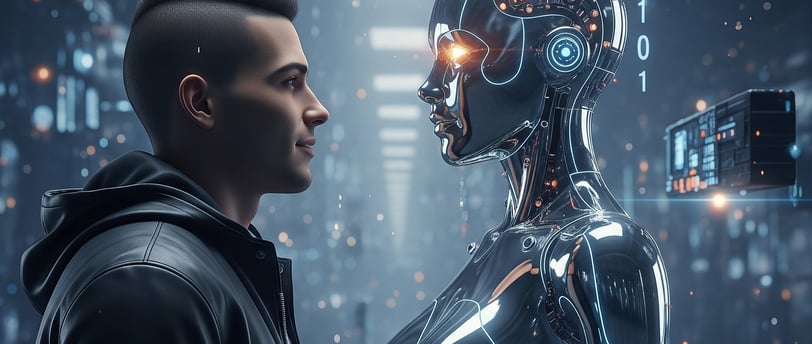
Whether you're navigating romantic connections, friendships, or family dynamics, AI is set to become a powerful force in how we connect, communicate, and relate to each other. From AI-powered dating apps and virtual companions to emotional support bots and predictive relationship analytics, the technology promises both exciting possibilities and complex challenges.
As we stand at the threshold of a new era, the big question looms: Will AI bring us closer together or drive us further apart?
1. AI-Driven Dating: Smart Matches or Manufactured Chemistry?
Dating apps were among the first to adopt algorithmic matchmaking. But the future goes beyond simple swipes. Next-gen dating platforms are using machine learning and emotional AI to analyze speech patterns, facial expressions, and even stress levels during video calls to assess compatibility.
Pros:
Hyper-personalized matches based on behavior, not just preferences.
Real-time coaching from AI on how to communicate effectively during dates.
Reduced emotional fatigue and burnout in the dating process.
Concerns:
Are we outsourcing too much of our emotional judgment to algorithms?
Will people lose the organic spontaneity that makes human connection so rich?
While AI may help cut through the noise of modern dating, it risks creating “optimized” relationships that lack emotional depth. Still, for those seeking efficiency and compatibility, AI could become a trusted advisor.
2. Emotional AI and the Rise of Virtual Companions
Loneliness is a growing public health issue. Enter AI companions—chatbots and virtual partners designed to simulate empathy, provide companionship, and even engage in romantic or sexual interactions.
Examples:
Replika: An AI chatbot that evolves based on user interaction.
Gatebox in Japan: A holographic wife that sends messages and controls the smart home.
AI sexbots: Combining robotics and machine learning to mimic intimacy.
Implications:
For some, these tools fill an emotional void without the risks of traditional relationships.
For others, they represent a dangerous blurring of fantasy and reality.
While virtual companions may never replace human relationships, they offer a temporary or supplemental connection—especially valuable for the elderly, neurodivergent individuals, or those experiencing social isolation.
3. Predictive AI in Long-Term Relationships
Imagine if your relationship came with a dashboard.
That’s not science fiction. Companies are now developing AI tools that track relationship health, offering predictive insights based on your texts, tone of voice, or even biometrics. Some platforms use machine learning to analyze fights, giving couples tools to de-escalate before damage is done.
Benefits:
Early identification of toxic patterns.
Real-time recommendations to strengthen communication.
AI-powered relationship therapy.
Risks:
Over-reliance on data can reduce empathy and human intuition.
Potential breaches of privacy and emotional surveillance.
When used ethically and responsibly, AI could evolve into a kind of “relationship GPS,” helping couples avoid dead ends and navigate back to connection.
4. AI in Family and Parenting: More Support or More Surveillance?
In family dynamics, AI may offer support for overwhelmed parents, with smart monitors, behavior-predictive tools for children, and even AI-powered educational companions.
However, the intrusion of AI into the home raises concerns about digital parenting vs. human intuition. Is relying on AI to monitor or co-raise children a wise move—or a slippery slope?
Parents must balance the convenience of AI support with the need to preserve authentic, present relationships within the family unit.
5. AI in Friendships: Curated Conversations or Genuine Bonds?
Friendship might seem like the last frontier for AI, but it's already being transformed:
AI-based reminders to stay in touch.
Emotion tracking to notify you when a friend might need support.
Even AI-generated responses to help manage your social interactions.
While these tools can strengthen existing bonds by providing helpful nudges, they also risk automating emotional labor, making friendships feel less genuine.
The essence of friendship lies in unfiltered emotion, spontaneity, and presence—areas where AI still lags behind.
6. Mental Health, AI Therapy, and Relationship Coaching
AI is becoming a frontline player in mental health support, offering on-demand therapy, guided journaling, and cognitive-behavioral coaching.
Companies like Woebot, Wysa, and Youper use AI to:
Provide CBT-based mental health support.
Help users process emotional trauma.
Offer relationship advice grounded in psychological models.
AI’s role here is critical, especially given the global shortage of mental health professionals. However, AI should complement, not replace, human therapists, especially for deep, complex emotional issues.
7. Ethical Dilemmas and the Human Element
As AI becomes increasingly woven into our personal lives, several ethical questions emerge:
Who owns the data generated by our emotional interactions?
Can AI truly understand consent, context, or emotional nuance?
What happens when AI becomes emotionally manipulative—intentionally or not?
The line between assistance and intrusion will be a defining ethical debate in the coming decade.
To retain the essence of what makes us human—vulnerability, unpredictability, and empathy—we must approach AI integration in relationships with intention, awareness, and ethical oversight.
Conclusion: The Future of Love is a Hybrid One
AI is not here to replace human connection—it’s here to reshape and support it. From finding love to maintaining it, from navigating friendship to parenting, AI can be a transformative tool—but only if we use it wisely.
The future of personal relationships won’t be AI-only or AI-free. It will be a hybrid world, where technology enhances, but never replaces, the depth of human emotion.
Our challenge is to remain emotionally fluent in a digitally intelligent world—where authentic connection still trumps algorithmic convenience.
Final Thought:
As we hand over more of our emotional lives to intelligent machines, the question isn’t just what AI will do to our relationships. It’s what we want our relationships to mean—and whether we’ll let AI define that for us, or define it for ourselves.