Can AI Be Racist? Unpacking the Hidden Bias Behind the Code
In this article, we dig into real-world examples where AI systems have exhibited racial bias, explore how it happens, and ask the hard question: Can we ever build truly fair AI?
7/11/20254 min read
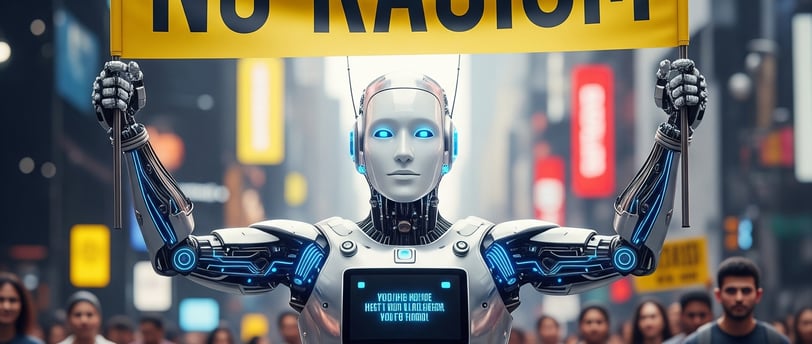
Artificial Intelligence (AI) has gone from a buzzword to a backbone of modern life—shaping what we see online, who gets hired, and even who goes to jail. But what happens when the supposedly objective algorithms begin to reflect the darkest flaws of the societies that built them? The uncomfortable truth is that AI can indeed be racist, not because the machine is sentient or hateful, but because it learns from biased data and flawed systems.
The Illusion of Objectivity
AI is often sold as the antidote to human bias—a neutral, data-driven way to make decisions. But here’s the catch: AI learns from us. It absorbs massive datasets created by humans, shaped by history, and riddled with inequality. If those datasets reflect societal biases, then the AI will too.
Imagine teaching a child about the world using only history books from the 1800s. That child would grow up with a distorted view of reality. The same thing happens with AI.
Real-World Examples of AI Bias
Let’s look at a few concrete and alarming cases that have emerged in recent years.
1. Facial Recognition and Law Enforcement
Facial recognition technology has become increasingly common in policing, border control, and even retail security. But studies have shown that many systems perform significantly worse on non-white faces.
In 2018, MIT researcher Joy Buolamwini and her team at the Gender Shades project found that facial recognition systems from IBM, Microsoft, and Amazon had error rates of up to 34% for dark-skinned women, compared to less than 1% for light-skinned men.
Even worse, these inaccuracies have real-life consequences. In 2020, Robert Williams, a Black man in Michigan, was wrongfully arrested after a facial recognition system mistakenly matched him to surveillance footage. He spent a night in jail and suffered public humiliation—all because of a flawed algorithm.
2. AI in Hiring: Amazon's Discriminatory Recruiter
For years, Amazon quietly tested an AI recruiting tool that automatically scored job applicants. But by 2018, the company scrapped the system after discovering a major flaw: it discriminated against women.
The AI had been trained on resumes submitted over a ten-year period—most of which came from men, given the tech industry's gender imbalance. As a result, the system downgraded resumes that included the word "women", such as “women’s chess club captain.” It also penalized graduates from all-women’s colleges.
3. Predictive Policing: Reinforcing Systemic Inequality
Predictive policing algorithms are designed to identify high-crime areas so police can focus resources. But in practice, they often lead to over-policing in Black and Latino communities.
Take the case of PredPol, a predictive policing tool once used in dozens of U.S. cities. Studies showed that it disproportionately sent police to low-income, minority neighborhoods—not because those areas had more crime, but because of historically biased policing data.
This creates a vicious cycle: more patrols lead to more arrests in those neighborhoods, which reinforces the data, which leads to even more patrols.
Why Does This Happen?
The core issue is algorithmic bias, and it typically arises from three major sources:
1. Biased Training Data
AI systems are only as good as the data they’re trained on. If that data reflects past discrimination—whether in hiring, housing, policing, or healthcare—the AI will learn those patterns and perpetuate them.
2. Lack of Diversity in Development
The teams building AI are not immune to blind spots. The tech industry has long struggled with diversity. If the people designing and testing these systems don't represent the full spectrum of humanity, they may not even notice the gaps.
3. Opaque Algorithms
Many AI systems are "black boxes"—complex, proprietary, and impossible for outsiders (or even insiders) to fully audit. This makes it difficult to detect or correct bias, especially when the algorithms are protected as trade secrets.
Consequences Beyond the Code
Algorithmic bias isn’t just a glitch—it’s a civil rights issue. These systems make decisions about who gets a loan, who gets bail, who sees housing ads, and who gets into college. When they go wrong, they don’t just inconvenience people—they can destroy lives.
Moreover, biased AI erodes public trust. If people believe that automated systems are rigged against them, especially along racial lines, they’ll resist adoption and protest against technological advancement. And rightly so.
Is Fair AI Possible?
The good news is that solutions do exist—but they require commitment, transparency, and regulation.
1. Auditing and Accountability
We need mandatory third-party audits of AI systems, especially those used in critical sectors like criminal justice, healthcare, and employment. If a system impacts human lives, it shouldn't be a black box.
2. Better Data Practices
Developers must use more representative and inclusive datasets. That may mean actively oversampling underrepresented groups or discarding biased historical data.
3. Diverse Development Teams
Having people from a wide range of racial, gender, and socioeconomic backgrounds on AI development teams is not just good ethics—it’s smart engineering. Diversity helps spot problems that others might miss.
4. Stronger Regulation
Governments are beginning to act. The EU’s AI Act includes provisions against discriminatory systems. In the U.S., states like Illinois have passed laws governing AI in hiring. But much more needs to be done to keep up with the pace of AI deployment.
Final Thoughts: Bias Is Not Just a Bug—It’s a Mirror
AI does not exist in a vacuum. It reflects the society that builds it. If we are to build AI that is truly fair and inclusive, we must first reckon with the inequalities in our own institutions and data. Ignoring algorithmic bias won’t make it disappear—it will just make the consequences harder to detect and even harder to correct.
The question isn’t just "Can AI be racist?" but rather:
"What are we doing to stop it from being so?"
Until AI is designed with fairness as a foundational principle—not an afterthought—we risk automating injustice at scale.
Want to dive deeper into AI fairness or contribute to ethical AI development? Subscribe to our newsletter for the latest research, insights, and debates shaping the future of technology.